What Is SPC Flooring?
SPC stands for Stone Plastic Composite. It is a rigid-core vinyl flooring product manufactured with a mineral-filled polymer core, typically incorporating calcium carbonate and PVC resin.
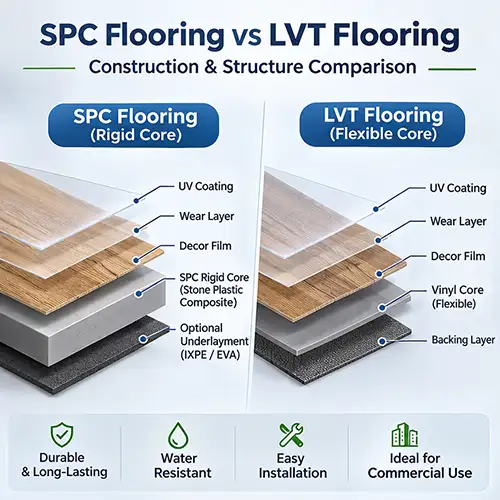
A standard SPC flooring structure includes:
UV-cured protective surface coating
Transparent wear layer
Printed decorative film
Rigid SPC core
Optional attached underlayment
The rigid core helps the plank maintain its shape and provides dimensional stability under suitable installation conditions.
Most SPC products use a click-lock installation system, making them suitable for many commercial renovation and new-build projects.
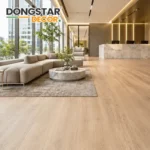
Dongstar Decor supplies SPC flooring in multiple thicknesses, wood-look and stone-look finishes, with customization options for international wholesale and project orders.
What Is LVT Flooring?
LVT stands for Luxury Vinyl Tile, a resilient flooring product designed to reproduce the appearance of wood, stone, and other decorative materials.
Traditional flexible LVT typically consists of a protective wear layer, decorative film, and vinyl-based backing or core layers.
Depending on the product, LVT may be installed using full-spread adhesive, pressure-sensitive adhesive, or a loose-lay system.
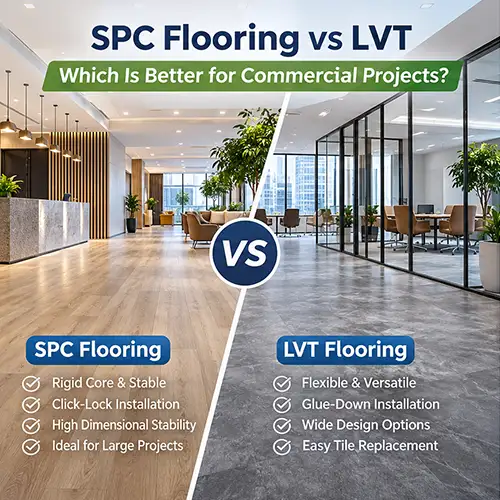
An important distinction: SPC is technically part of the broader luxury vinyl flooring family. In commercial purchasing, however, “SPC vs LVT” usually refers to rigid-core SPC compared with traditional flexible LVT.
Understanding this distinction helps buyers avoid comparing products based on marketing terminology alone.
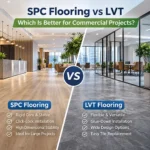
SPC Flooring vs LVT: Key Differences
| Feature | SPC Flooring | Traditional Flexible LVT |
|---|---|---|
| Core Construction | Rigid mineral-polymer composite | Flexible vinyl construction |
| Flexibility | Low | Higher |
| Installation | Commonly click-lock floating | Commonly glue-down or loose-lay |
| Dimensional Stability | Generally high | Depends on formulation and installation |
| Water Resistance | Water-resistant core | Water-resistant vinyl construction |
| Subfloor Preparation | Requires a flat, stable substrate | Requires a smooth, properly prepared substrate |
| Surface Durability | Depends on wear layer and coating | Depends on wear layer and coating |
| Repair | Individual plank replacement may require disassembly | Glued-down tiles can often be replaced individually |
| Typical Applications | Offices, hotels, retail, residential developments | Retail, offices, hospitality, institutional interiors |
Neither flooring type is automatically superior in every performance category. The final result depends on the product specification and installation system.
1. Durability: Is SPC Stronger Than LVT?
SPC flooring has a rigid composite core that provides resistance to deformation under suitable loading conditions.
This makes it attractive for many commercial interiors where dimensional stability is important.
However, a rigid core does not automatically mean better scratch or wear resistance.
Surface durability depends primarily on:
Wear-layer thickness and composition
Surface coating
Abrasion resistance
Point-load performance
Rolling-load resistance
Installation quality
Traditional LVT can also deliver excellent commercial durability when specified with an appropriate wear layer and adhesive system.
For busy retail areas or hotel corridors, buyers should compare documented wear resistance and loading performance rather than relying on total plank thickness.
2. Water Resistance: Which Flooring Performs Better?
Both SPC and traditional LVT are highly resistant to water exposure because their principal structural materials are vinyl-based.
SPC’s mineral-polymer core does not swell in the same way as conventional wood-based flooring.
However, neither material should be treated as a complete waterproofing system.
Water can still reach the subfloor through joints, edges, penetrations, or poorly detailed installation areas.
For moisture-prone commercial spaces, verify subfloor moisture conditions, joint requirements, perimeter detailing, and the manufacturer’s installation instructions.
3. Installation: Click-Lock SPC vs Glue-Down LVT
Installation is one of the clearest differences between these products.
SPC Flooring Installation
Most rigid-core SPC flooring uses a click-lock system.
Potential advantages include:
No full-spread flooring adhesive for typical floating installations
Efficient plank assembly
Suitable for many renovation projects
Installation over approved existing substrates
Reduced adhesive-related installation processes
However, floating SPC requires suitable subfloor flatness, expansion allowances, and careful treatment of fixed fixtures and transitions.
LVT Flooring Installation
Traditional commercial LVT frequently uses adhesive installation.
Its advantages may include:
Secure bonding to the prepared substrate
Flexible layout options
Compatibility with certain heavy rolling-load applications
Easier replacement of individual glued-down tiles
The trade-off is that subfloor preparation, adhesive selection, moisture control, and curing requirements may increase installation complexity.
For large commercial projects, the installation method should be selected according to the building’s operating conditions—not simply the fastest installation claim.
4. SPC vs LVT Cost: Which Offers Better Project Value?
The purchase price alone rarely provides a complete comparison.
Commercial flooring costs include material, transportation, subfloor preparation, installation labor, accessories, maintenance, and potential replacement.
| Cost Factor | SPC Flooring | Traditional LVT |
|---|---|---|
| Material Price | Varies by construction and specification | Varies by grade and specification |
| Installation Labor | Potentially lower for suitable floating installations | Depends on adhesive system and substrate |
| Subfloor Preparation | Flatness and stability are critical | Smoothness and adhesive compatibility are critical |
| Accessories | Underlayment, trims, transitions where required | Adhesive, trims, transitions where required |
| Maintenance | Generally straightforward | Generally straightforward |
| Replacement | May involve dismantling adjacent planks | Individual tiles may be easier to replace |
For importers purchasing container quantities, freight efficiency also matters. Compare flooring coverage per container, pallet configuration, product weight, and delivered cost per square meter.
A cheaper quotation can become more expensive if installation requirements or replacement costs are overlooked.
5. Which Flooring Is Better for Different Commercial Applications?
Hotels and Hospitality Projects
SPC is a practical option for many hotel guest rooms, corridors, and serviced apartments where rigid-core flooring and decorative wood finishes are required.
Glue-down LVT may be preferred in areas with particular rolling-load, repair, or installation requirements.
Offices and Commercial Buildings
Both flooring types can work well in offices.
SPC may offer advantages for suitable floating-floor renovations, while commercial LVT can be attractive where fixed installation and localized replacement are important.
Retail Stores and Showrooms
Retail environments require careful evaluation of foot traffic, display fixtures, cleaning equipment, and rolling loads.
Heavy fixtures or frequent equipment movement may favor specific glue-down LVT systems, although appropriately rated SPC products can also be considered.
Apartment and Mixed-Use Developments
SPC is frequently selected for multi-unit residential developments because of its rigid-core construction, decorative finishes, and click-lock installation.
For multi-story buildings, acoustic requirements should be evaluated using the complete floor-and-ceiling assembly, including any underlayment.
6. SPC Flooring Specifications Commercial Buyers Should Compare
When purchasing SPC flooring wholesale, use a consistent technical specification rather than comparing catalog descriptions alone.
| Specification | Common Options or Requirements |
|---|---|
| Total Thickness | 4 mm, 5 mm, 6 mm and other available options |
| Wear Layer | 0.3 mm, 0.5 mm, 0.7 mm, depending on product |
| Core | Mineral-filled rigid polymer composite |
| Surface | UV-cured protective coating |
| Designs | Wood-look, stone-look, custom finishes |
| Installation | Click-lock |
| Underlayment | Optional IXPE or EVA, subject to configuration |
| Performance | Wear, indentation, dimensional stability, slip resistance |
| Documentation | Applicable fire, emissions, and performance reports |
A 6 mm plank is not necessarily more wear-resistant than a 5 mm plank. The wear layer, surface treatment, core formulation, and locking system all contribute to performance.
Dongstar SPC Flooring Options
Dongstar Decor’s published product range includes:
Thickness: 4 mm, 5 mm, and 6 mm, with custom options
Plank dimensions: 6 × 36 inches and 7 × 48 inches, with custom sizes available
Surface: UV-cured protective coating
Installation: Click-lock system
Designs: Wood-look, stone-look, and customized decorative finishes
These specifications provide a starting point for project selection. Final availability and performance documentation should be confirmed for the selected construction.
7. Why Consider Dongstar Decor for Wholesale SPC Flooring?
For international distributors and contractors, a flooring supplier must support consistent specifications and reliable production, not simply offer a competitive unit price.
Dongstar Decor operates a dedicated SPC flooring workshop and reports production capacity of approximately 100 containers per month.
Its product range covers multiple plank dimensions, thicknesses, and decorative finishes, allowing buyers to evaluate options for different markets and project requirements.
For bulk procurement, Dongstar can be considered for:
SPC flooring product selection
Customized dimensions and surface designs
Commercial project specification discussions
Container-based purchasing
Export order coordination
Before confirming an order, buyers should request the relevant technical datasheet, approved samples, production schedule, and market-specific test documentation.
Explore Dongstar SPC Flooring Products for available designs and specifications.
FAQs About SPC Flooring vs LVT
1. Is SPC flooring better than LVT for commercial buildings?
SPC is often preferable where rigid-core construction and click-lock installation are priorities. Traditional glue-down LVT may be better for certain heavy-load environments or projects requiring easier localized repairs. The decision should follow the project specification.
2. Which is more durable, SPC or LVT?
Neither material is automatically more durable. Wear-layer quality, abrasion resistance, surface coating, loading performance, and installation conditions determine suitability.
3. Is SPC flooring more waterproof than LVT?
Both products offer strong water resistance. SPC has a moisture-resistant rigid core, while traditional LVT is also vinyl-based. Neither replaces the waterproofing requirements of the complete floor assembly.
4. What SPC flooring thickness is suitable for commercial projects?
Common options include 4 mm, 5 mm, and 6 mm. Commercial suitability depends on the complete product specification, particularly wear-layer thickness, loading performance, and manufacturer recommendations.
5. Is SPC flooring cheaper than LVT?
Not necessarily. Material prices vary, and total project costs depend on installation labor, substrate preparation, freight, accessories, and maintenance. Buyers should compare delivered and installed costs.
6. Can SPC flooring be customized for wholesale orders?
Yes. Manufacturers such as Dongstar Decor offer options for plank dimensions, thicknesses, and decorative finishes. MOQ, available constructions, and lead times should be confirmed before ordering.
Conclusion: SPC or LVT for Your Next Project?
SPC flooring and traditional LVT both have established roles in commercial interiors.
SPC is particularly attractive for projects seeking rigid-core stability, decorative finishes, and efficient floating installation. Glue-down LVT remains a strong alternative where fixed installation, flexibility, or individual tile replacement is important.
For distributors, importers, and commercial contractors, the best purchasing decision starts with the project requirements and verified product performance.
Looking for a reliable SPC flooring supplier for your next commercial project or wholesale order?
Explore Dongstar Decor’s SPC Flooring and request product specifications, available finishes, and a quotation based on your purchasing requirements.
Recommended Reading
- All Posts
- Acoustic Panel
- Blog
- Industry News
- Product Trends
- PS Wall Panel
- PU Stone Panel
- SPC Flooring
- UV Marble Sheet
- WPC Wall Panel
Compare SPC flooring and LVT for commercial projects, including durability, installation, costs, and bulk purchasing considerations.
Commercial flooring has to do much more than look good. In a hotel, office, retail store, restaurant, or public building, the floor is exposed to heavy foot traffic, cleaning, rolling...
When sourcing SPC Flooring for large-scale projects, thickness is often the first spec buyers compare—but it’s also one of the most misunderstood. Many project buyers assume “thicker is always better.”...
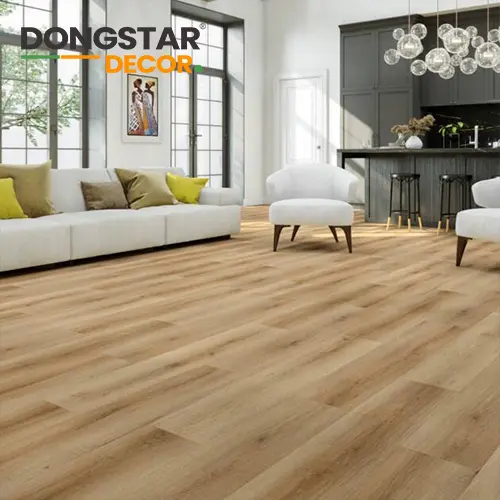
When homeowners or project managers think about flooring options that balance style and endurance, SPC Flooring has rapidly climbed the ranks as a top contender. From sleek visual appeal to...
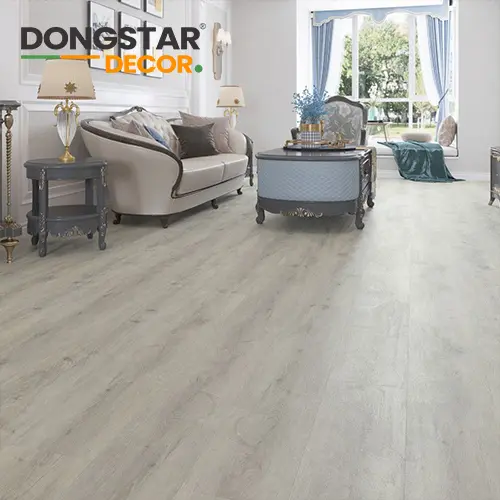
Commercial spaces demand flooring that can withstand heavy traffic, look professional, perform under pressure, and remain cost-efficient in the long run. This is where SPC Flooring stands out. Over the...
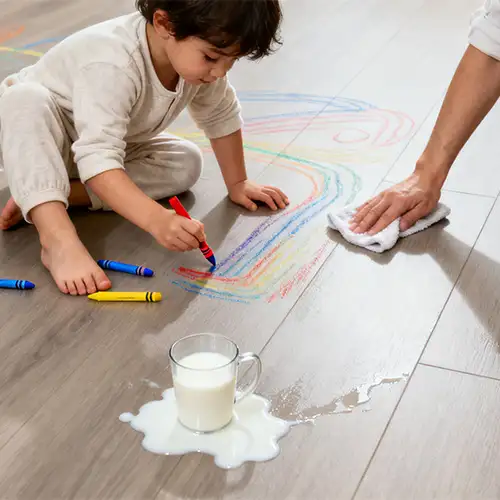
Living with pets and kids means your floors face constant challenges. SPC Flooring provides the ultimate defense, combining superior durability with practical benefits. This waterproof flooring solution resists scratches, spills,...