Why Supplier Selection Matters More Than Factory Price
If you’re buying WPC wall panels for a small renovation, a low quotation may seem attractive.
For a hotel, office development, retail chain, distributor warehouse, or container-level import order, the calculation is very different.
A difference of a few cents per square meter can look impressive on a quotation sheet. But if the panels arrive with inconsistent colors, damaged edges, poor packaging, delayed production, or missing technical documents, that initial saving can disappear very quickly.
For professional buyers, the better question isn’t:
“Who offers the lowest price?”
It’s:
“Which manufacturer can consistently deliver the required product, quality, documentation, quantity, and schedule?”
That distinction is important when selecting a WPC Wall Panel Manufacturer in China.
Google’s current guidance for AI Overviews and AI Mode also reinforces the value of original, useful, people-first information rather than content created simply to manipulate rankings.
For a B2B buyer, this means a good supplier guide should answer practical questions that arise before a purchase—not simply repeat generic descriptions of WPC.
What Makes a Reliable WPC Wall Panel Manufacturer?
A reliable manufacturer should be able to demonstrate more than attractive product photographs.
You need evidence of manufacturing capability.
For large commercial orders, evaluate the supplier across five areas:
Production capability
Product consistency
Quality control
Documentation and compliance
Export and project experience
A factory may be excellent at producing one attractive sample but struggle with a 10-container order.
That’s why procurement teams should evaluate the complete supply chain before approving a supplier.
The strongest manufacturers can explain how raw materials are controlled, how production batches are monitored, how finished goods are inspected, and how products are packed for international transportation.
Manufacturer vs Trading Company: What Should Importers Choose?
This is one of the first questions international buyers should answer.
A trading company isn’t automatically a bad choice. Some trading companies have strong technical teams and excellent factory networks.
However, when the project requires:
Large quantities
Custom specifications
Stable repeat orders
OEM production
Product development
Strict quality control
direct communication with a WPC Wall Panel Factory can provide major advantages.
A direct manufacturer may offer better visibility into:
Production schedules
Raw materials
Product specifications
Quality inspections
Packaging
Customization
Production capacity
For a long-term distributor or importer, that visibility can be more valuable than a small difference in the initial quotation.
8 Things to Check Before Choosing a China WPC Wall Panel Supplier
Production Capacity and Factory Equipment
Production capacity should be one of the first things you investigate.
Ask the supplier:
How many production lines are operating?
What is the monthly output?
How many containers can be produced?
What is the normal lead time?
Can production capacity be reserved for repeat customers?
Capacity claims should be supported by factory photographs, production-line information, videos, inspection records, or a factory visit when appropriate.
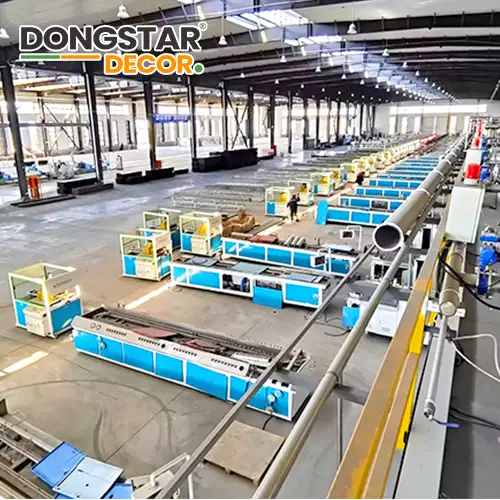
Dongstar Decor states that its WPC workshop has 65 production lines and approximately 130 containers of monthly output. The company also describes a three-stage quality process covering raw materials, production monitoring, and final inspection. These are useful examples of the type of manufacturing information a buyer should ask suppliers to provide.
For a large project, capacity isn’t about producing the largest possible number of panels.
It’s about producing your required quantity consistently and on schedule.
Raw Material and Product Consistency
Two panels can look almost identical in a showroom and perform differently in production.
Ask for information about:
WPC formulation
Wood fiber content
Polymer type
Density
Panel thickness
Surface treatment
Color consistency
Dimensional tolerances
You don’t necessarily need the supplier to reveal proprietary formulations.
But you should receive enough technical information to compare one manufacturer’s product with another.
For repeat orders, consistency is particularly important.
Imagine importing 5,000 square meters for a hotel renovation and ordering another 5,000 square meters six months later. If the color, texture, dimensions, or surface finish changes noticeably, the installation team may have a serious problem.
A reliable manufacturer should therefore have batch-control procedures.
Quality Control and Pre-Shipment Inspection
A factory’s quality-control process should not begin when the container is ready to leave.
Ideally, quality is controlled throughout production.
A practical QC process may include:
Raw material inspection → production monitoring → dimensional checks → surface inspection → finished-product inspection → packing inspection → loading inspection
For importers, third-party inspection can provide another layer of protection.
Before shipment, inspect or verify:
Quantity
Dimensions
Thickness
Color
Surface quality
Packaging
Accessories
Carton markings
Container loading
This is especially important for first orders.
The cost of an inspection is usually small compared with the cost of replacing a container of non-conforming products.
Certifications and Technical Documentation
Certification is often misunderstood by buyers.
Don’t simply ask:
“Do you have CE?”
Ask a more useful question:
“Which standard applies to this exact product and intended application, and can you provide the complete supporting documentation?”
For European projects, this distinction matters.
The European Commission explains that construction products covered by a harmonised standard or European Technical Assessment may require a Declaration of Performance and CE marking, while applicable performance requirements depend on the product and intended use.
Relevant documentation may include:
Product technical datasheet
Fire-test reports
Environmental documentation
Declaration of Performance, where applicable
Test reports
Quality-management documentation
Installation instructions
Maintenance instructions
Never assume that one certificate automatically makes a product suitable for every project or country.
The project specification and local requirements always need to be checked.
Product Development and Customization
For distributors and large project buyers, customization can be a major advantage.
A capable manufacturer may offer:
Custom colors
Custom surface textures
Custom dimensions
OEM packaging
Private-label production
Special profiles
Matching trims and accessories
But customization shouldn’t be limited to changing a color.
Ask whether the supplier can handle technical development from:
Drawing → sample → approval → mass production → quality inspection → shipment
This becomes particularly important when an architect or developer has specified a unique wall finish.
Packaging, Loading and Export Experience
Good panels can still arrive damaged if they’re poorly packed.
International transportation involves:
Factory handling
Truck transportation
Container loading
Sea transportation
Port handling
Customs clearance
Local delivery
Ask for photographs or videos of actual export packing.
Check whether the supplier uses:
Corner protection
Protective film where appropriate
Moisture protection
Strong cartons or pallets
Internal separators
Secure container loading
Also ask how many panels or square meters are loaded per container.
This helps you calculate the actual landed cost rather than comparing factory prices alone.
MOQ, Lead Time and Production Planning
A low MOQ can be attractive for a new distributor.
But for major projects, production planning is more important.
Ask for a written estimate covering:
MOQ
Sample lead time
Mass-production lead time
Packaging time
Loading schedule
Peak-season capacity
Repeat-order lead time
For projects involving several containers, don’t wait until the previous shipment is nearly sold out before ordering again.
A professional supplier should be able to help you create a rolling production schedule.
Communication and After-Sales Support
This sounds simple, but it can make or break an international supplier relationship.
Before ordering, test the supplier’s communication.
Do they:
Answer technical questions clearly?
Send complete quotations?
Understand drawings?
Explain specifications?
Respond quickly to problems?
Provide production updates?
If communication is poor before the order, it rarely becomes better after payment.
A strong supplier should also have a clear process for handling:
Product defects
Transport damage
Missing accessories
Installation questions
Warranty claims
Dongstar’s support center, for example, provides WPC installation, maintenance, technical-support, and product-document resources for customers.
How to Verify a WPC Wall Panel Factory in China
You don’t need to fly to China before every purchase.
There are several ways to conduct basic supplier due diligence remotely.
Step 1: Check the Company’s Physical Presence
Request:
Factory address
Factory photographs
Production-line videos
Company registration information
Export information
Product catalogue
Then compare the information across the supplier’s website, quotation, business documents, and communication.
Inconsistencies deserve attention.
Step 2: Request a Live Factory Video Call
A recorded video is useful.
A live video call is better.
Ask the supplier to walk through:
Raw-material area
Production lines
Quality-control area
Finished-product warehouse
Packing area
You don’t need a Hollywood production.
A simple live factory walkthrough can tell you a lot.
Step 3: Ask for Recent Production Evidence
Ask to see recent production of the same or similar product.
This helps distinguish an actual manufacturer from a company relying heavily on third-party sourcing.
Step 4: Arrange an Independent Inspection
For a first container or high-value project, independent inspection can be worthwhile.
A supplier that welcomes reasonable inspection procedures is generally easier to work with than one that avoids transparency.
What Samples Should You Request?
Don’t request only one attractive sample.
For a serious project, request a small sample package.
Ideally, include:
Main color
Alternative color
Surface texture
Cross-section
Accessories
Trim profiles
Different production batches when available
If the project requires fire performance or other regulated characteristics, request the documentation associated with the exact product—not a similar-looking product.
You should also test the installation system.
Check:
Cutting
Joint alignment
Fixing
Edge finishing
Color consistency
Surface cleaning
A sample should answer a simple question:
“Would I be comfortable installing this product across a commercial project?”
Questions to Ask Before Placing a Bulk Order
Before signing a purchase contract, ask the manufacturer these questions:
| Question | Why It Matters |
|---|---|
| What is the exact WPC specification? | Establishes product baseline |
| What is the production lead time? | Protects project schedule |
| What is the MOQ? | Determines purchasing efficiency |
| What is the container loading quantity? | Helps calculate landed cost |
| What tests are available? | Supports project approval |
| What is the warranty? | Defines post-sale responsibility |
| How is QC performed? | Reduces quality risk |
| Can you provide samples? | Allows physical verification |
| Can you customize the product? | Supports project specifications |
| How is the product packaged? | Reduces transit damage |
| What happens if goods fail inspection? | Clarifies commercial risk |
A good quotation should be specific enough that another supplier could quote against the same specification.
That’s how you make a real comparison.
Red Flags That Should Make You Walk Away
Some warning signs are easy to recognize.
Be cautious if a supplier:
Refuses to provide a factory address
Cannot explain basic product specifications
Offers unusually low pricing without explanation
Sends certificates unrelated to the exact product
Refuses reasonable third-party inspection
Changes specifications after quotation
Cannot provide samples
Gives vague delivery dates
Has inconsistent company information
Pushes for payment before confirming specifications
Another major warning sign is an unusually broad catalogue with no clear manufacturing specialization.
A genuine manufacturer may have multiple product lines, but should still be able to explain exactly which products it manufactures and which processes are outsourced.
Why China Remains Important for WPC Wall Panel Sourcing
China remains a major manufacturing base for interior decorative materials because the supply chain includes raw materials, extrusion equipment, surface finishing, packaging, accessories, logistics, and export services.
For international buyers, the advantage isn’t simply lower factory pricing.
A mature manufacturing cluster can also provide:
Multiple surface technologies
Large production capacity
Flexible customization
Access to accessories
Container-scale logistics
OEM capabilities
However, buyers should not treat “Made in China” as a guarantee of quality.
China has excellent manufacturers and poor manufacturers, just like every other major manufacturing market.
The goal is to identify the factory whose product quality, capacity, documentation, communication, and commercial terms match your project.
How Dongstar Decor Approaches Large-Volume Projects
For buyers evaluating a potential WPC Wall Panel Manufacturer, supplier transparency is important.
Dongstar Decor describes itself as an interior decoration materials manufacturer with more than 30 years of industry history and a Decor factory established in 2014. Its website states that the company supplies customers in more than 100 countries and operates a WPC workshop with 65 production lines and approximately 130 containers of monthly output.
The company also describes project support for contractors, distributors, and EPC customers, including dedicated coordination for large projects, customization capabilities, and quality-control procedures.
For a potential buyer, the important point isn’t simply the number of production lines.
It’s whether the supplier can demonstrate that its stated capability matches your actual project requirements.
For a serious commercial inquiry, the most useful next step is to provide:
Project location
Estimated square meters
Product style
Preferred color
Target delivery date
Required certifications
Installation method
Container or order quantity
That gives the manufacturer enough information to provide a meaningful quotation rather than a generic price.
FAQs
1. How do I find a reliable WPC Wall Panel Manufacturer in China?
Start by checking factory capability, production capacity, product specifications, quality-control procedures, export experience, certifications, samples, and customer references. A live factory video inspection and independent pre-shipment inspection can provide additional confidence.
2. What is the difference between a WPC Wall Panel Manufacturer and a trading company?
A manufacturer controls its own production process, while a trading company may source products from one or more factories. Both can be legitimate, but direct manufacturer relationships can be particularly useful for customized products and large repeat orders.
3. What documents should a WPC Wall Panel Factory provide?
Depending on the product and target market, request a technical datasheet, applicable test reports, fire-performance documentation, installation instructions, warranty information, and relevant conformity documentation.
4. Are China WPC Wall Panels suitable for European projects?
They can be, provided the specific product meets the requirements applicable to its intended use and destination market. For EU construction products, requirements under the Construction Products Regulation and relevant harmonised technical specifications need to be assessed rather than assumed.
5. Should I inspect WPC wall panels before shipment?
For a first order, high-value shipment, or large commercial project, pre-shipment inspection is a sensible risk-control measure. The inspection should verify the agreed specification, quantity, appearance, packaging, and other contractual requirements.
6. Can a Chinese WPC manufacturer produce custom designs?
Many established factories offer OEM and customization services, but capability varies. Ask for examples of previous customized projects and confirm the sample approval and mass-production process before placing the order.
7. How can I compare quotations from different WPC suppliers?
Use the same specification for every supplier. Compare material composition, thickness, dimensions, surface finish, accessories, packaging, MOQ, loading quantity, payment terms, lead time, certifications, and shipping terms—not just the unit price.
8. What is the most important factor when selecting a WPC manufacturer?
For large projects, consistency is arguably more important than the lowest price. A manufacturer that can repeatedly deliver the same quality, specification, quantity, and schedule is usually more valuable than a supplier offering a cheaper but uncertain quotation.
Final Checklist for Choosing a Manufacturer
Before approving a WPC Wall Panel Factory, make sure you can answer “yes” to most of these questions:
Does the factory have verifiable production capability?
Can it provide samples of the exact product?
Are specifications clearly documented?
Can it provide relevant testing and compliance documents?
Does it have experience exporting to your market?
Is the production schedule realistic?
Is packaging suitable for long-distance shipping?
Can the factory support customization if required?
Can you arrange inspection before shipment?
Are warranty and defect procedures clearly defined?
Is communication fast and technically competent?
Does the total landed cost make sense?
If the answer is yes, you’re no longer choosing based on a catalogue.
You’re choosing based on evidence.
Final Takeaway
Finding a reliable WPC Wall Panel Manufacturer in China isn’t about discovering the supplier with the cheapest square-meter price.
It’s about reducing uncertainty.
The right manufacturer should be able to demonstrate:
Factory capability + consistent quality + appropriate documentation + export experience + transparent communication + dependable production
For importers, distributors, contractors, and project developers, this approach creates a much stronger foundation for long-term purchasing.
China can offer significant advantages in WPC wall panel manufacturing, but professional buyers should still conduct proper due diligence before committing to a large order.
And that’s the key point: don’t choose a supplier because the catalogue looks good. Choose one because the factory, product, documents, processes, and people stand up to scrutiny.
For buyers evaluating Dongstar Decor as a potential supplier, you can review its WPC product information, installation resources, manufacturing information, and request a project quotation or sample through the company’s website.
Recommended Reading
- All Posts
- Acoustic Panel
- Blog
- Industry News
- Product Trends
- PS Wall Panel
- PU Stone Panel
- SPC Flooring
- UV Marble Sheet
- WPC Wall Panel

Interior WPC Wall Panels: Complete Buying Guide for Commercial Projects Commercial interior design has changed significantly over the last decade. Property developers, hotel groups, office owners, architects, and contractors are...

The global interior decoration market is changing quickly. Across the United States and Europe, developers, contractors, wholesalers, and distributors are increasingly switching from traditional MDF and wood materials to modern...

Introduction to Indoor WPC Wall Panel What is an Indoor WPC Wall Panel? An Indoor WPC Wall Panel is a modern composite decorative material made from wood fiber and plastic...

As interior projects move faster and budgets become tighter, B2B buyers are rethinking traditional wall materials. In 2026, Indoor WPC Wall Panel solutions are gaining strong traction among wholesalers, contractors,...

When designing with interior WPC wall panels, choosing the right color combinations can transform your space from ordinary to extraordinary. WPC panels offer incredible versatility, durability, and aesthetic appeal, making...

Installing Interior WPC (Wood Plastic Composite) Wall Panels is a straightforward process, making them an excellent choice for home and commercial interior décor. Here’s a step-by-step guide to ensure proper...