Table of Contents
As interior projects move faster and budgets become tighter, B2B buyers are rethinking traditional wall materials. In 2026, Indoor WPC Wall Panel solutions are gaining strong traction among wholesalers, contractors, and project developers who need products that perform reliably across different climates, building standards, and usage scenarios.
This article focuses on what matters most to B2B decision-makers—cost efficiency, installation speed, durability, compliance, and long-term value—while outlining the key Indoor WPC Wall Panel trends shaping the global interior market in 2026.
1. Consistent Quality for Large-Scale Projects
For B2B buyers, product consistency is critical. In 2026, Indoor WPC Wall Panels are increasingly specified in large commercial and residential projects because they offer:
- Stable dimensions with minimal batch variation
- Uniform surface finish for mass installations
- Reduced risk of on-site rejection or rework
Compared to natural wood or veneer panels, WPC panels provide predictable performance, which is essential for hotels, apartments, offices, and retail chains.
2. Cost Control and Long-Term Value
While initial material cost matters, B2B buyers are more focused on total project cost. Indoor WPC Wall Panels help control budgets through:
- Lower maintenance requirements
- Longer service life
- Resistance to moisture, termites, and deformation
In 2026, more developers are choosing WPC panels to avoid post-installation issues that often increase long-term operational costs.
3. Faster Installation = Higher Project Efficiency
Labor shortages and tight timelines are pushing contractors to select materials that install quickly. Modern Indoor WPC Wall Panel systems are designed for:
- Clip or batten-based installation
- Reduced surface preparation
- Faster panel alignment and replacement
This makes them particularly suitable for large-volume interior projects, where installation efficiency directly impacts profitability.
4. Compliance with International Building Standards
For export-oriented buyers, compliance is non-negotiable. In 2026, Indoor WPC Wall Panels are increasingly manufactured to meet:
- Fire-retardant requirements for commercial interiors
- Indoor air quality and low-VOC standards
- Safety requirements for public buildings
These features make WPC panels easier to specify across different regions, reducing approval risks during project planning.
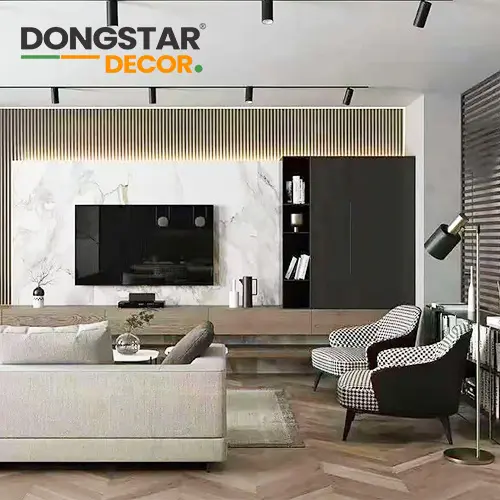
5. Design Flexibility for Commercial Interiors
Commercial interiors require balance—attractive design without compromising durability. Indoor WPC Wall Panels now offer:
- Wood, stone, and fabric-inspired finishes
- Custom sizes for project-based orders
- Neutral color palettes preferred in corporate and hospitality spaces
This allows designers and developers to maintain visual consistency across multiple locations or phases of a project.
6. Reliable Supply and Scalability
One of the strongest advantages of Indoor WPC Wall Panels for B2B buyers is supply stability. Unlike natural wood materials, WPC panels are less affected by:
- Seasonal raw material shortages
- Quality fluctuations
- Long lead times
For wholesalers and distributors, this ensures stable inventory planning and predictable delivery schedules in 2026.
Why B2B Buyers Are Choosing Indoor WPC Wall Panels in 2026
Indoor WPC Wall Panels are no longer positioned as a niche product. In 2026, they are becoming a standard interior wall solution for projects that demand efficiency, durability, and controlled costs.
For wholesalers, contractors, and project developers, WPC panels offer a practical balance between performance and design—making them a reliable choice in an increasingly competitive market.